That question has two parts. Generating replacement keys is only the first. Every pipeline, application, and downstream vault that uses an old key must receive its replacement before the old value is invalidated. At scale, manual rotation becomes an incident inside the incident.
In this article, we will show how One Identity Safeguard for Privileged Passwords and One Identity Safeguard Secrets Broker for DevOps can turn that problem into one managed workflow: discover thousands of AWS IAM keys, rotate them centrally, and push each replacement to its configured consumers. With the environment mapped and tested in advance, work that could take days can become a minutes-scale administrative operation. Actual completion time depends on AWS response times, the number of keys, and whether every downstream integration succeeds.
Step 1: Safeguard Discovers AWS IAM Keys
AWS is a natively supported Safeguard platform. An administrator adds each AWS account as a cloud platform asset and configures an IAM service account. Safeguard can then run scheduled discovery across the AWS accounts in scope, identify IAM accounts and their API keys, and apply discovery rules that determine which findings are automatically brought under management.
This is what keeps the inventory current. If another team creates a key after the initial deployment, the next scheduled discovery can surface it instead of leaving it outside the rotation program. Safeguard becomes the central place to see the managed AWS keys across multiple accounts.
Discovery must still be governed. Administrators define AWS permissions, schedules, discovery rules, ownership, and the profiles assigned to managed accounts. Native support removes the need to build an AWS connector; it does not remove the need to configure it correctly.
Step 2: Safeguard Regularly Rotates AWS IAM Keys
Secure storage is useful, but a copied static key remains valid until it is replaced or revoked. NIST SP 800-53 IA-5 addresses authenticator lifetimes and event-driven changes, while NIST's zero-trust model rejects implicit trust and treats the network as potentially compromised.
For long-term IAM keys that cannot be replaced with roles and temporary credentials, AWS recommends rotation every 90 days or less. Safeguard natively supports checking and changing API keys associated with its AWS connector and can apply configured change schedules to managed accounts.
Instead of tracking 1,000 independent reminders, the administrator defines rotation policy centrally. Safeguard handles the managed AWS key lifecycle and records the results, while failed changes can be identified for follow-up.
Step 3: Safeguard Secrets Broker Updates Applications
Rotation is not finished when AWS issues a new key. It is finished when the authorized consumers have the replacement and the old key can be retired without stopping the business.
Safeguard Secrets Broker is a companion secret-distribution service. It listens for credential-change events from Safeguard, retrieves the changed secret, and pushes it through mapped plugins to the places that use it. Those destinations can include CI/CD pipelines, DevOps platforms, and other secrets vaults. Supported plugins cover established targets, and custom plugins can connect applications or pipelines with an appropriate update interface.
Each consumer must be mapped and tested beforehand. Secrets Broker cannot update an application Safeguard does not know about, and the application must be capable of accepting or reloading the replacement. Once that plumbing is in place, however, the same distribution workflow can run during routine rotation and an emergency.
Incident Response: Putting It All Together
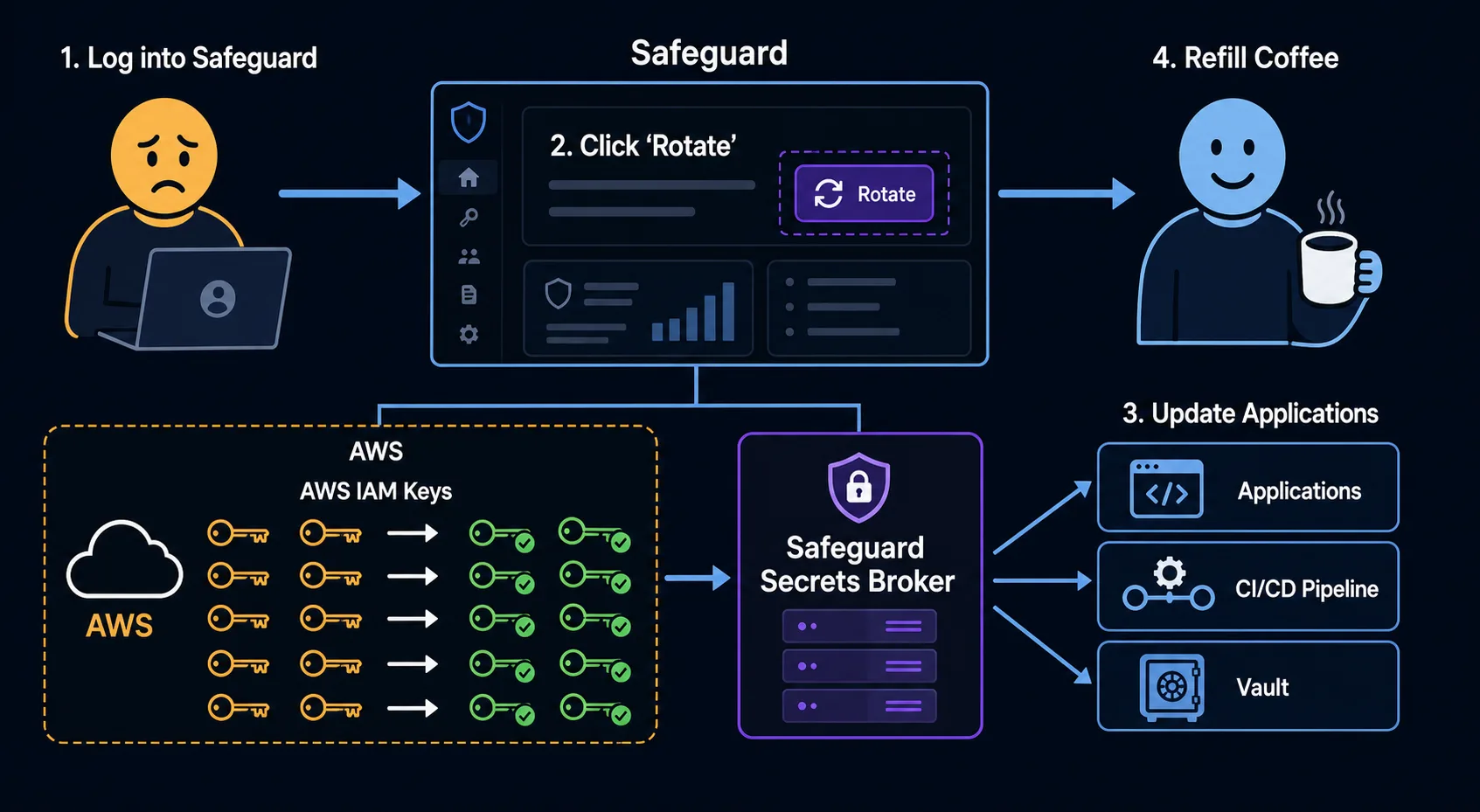
With Safeguard and Safeguard Secrets Broker, a stressful credential-response task becomes a simple, coordinated exercise. An administrator:
- Logs into Safeguard.
- Selects and rotates all of the managed AWS IAM keys in scope.
- Refills their coffee.
Safeguard rotates the managed keys, and Secrets Broker updates the configured applications while the administrator sips.
Move From Rotation to Reliable Distribution
WTSS provides privileged access management services for credential discovery, Safeguard design, integrations, rotation workflows, and operational handoff. We can also assess whether an AWS key should be vaulted, redesigned around an IAM role, or removed.
Explore Secrets Synchronization